
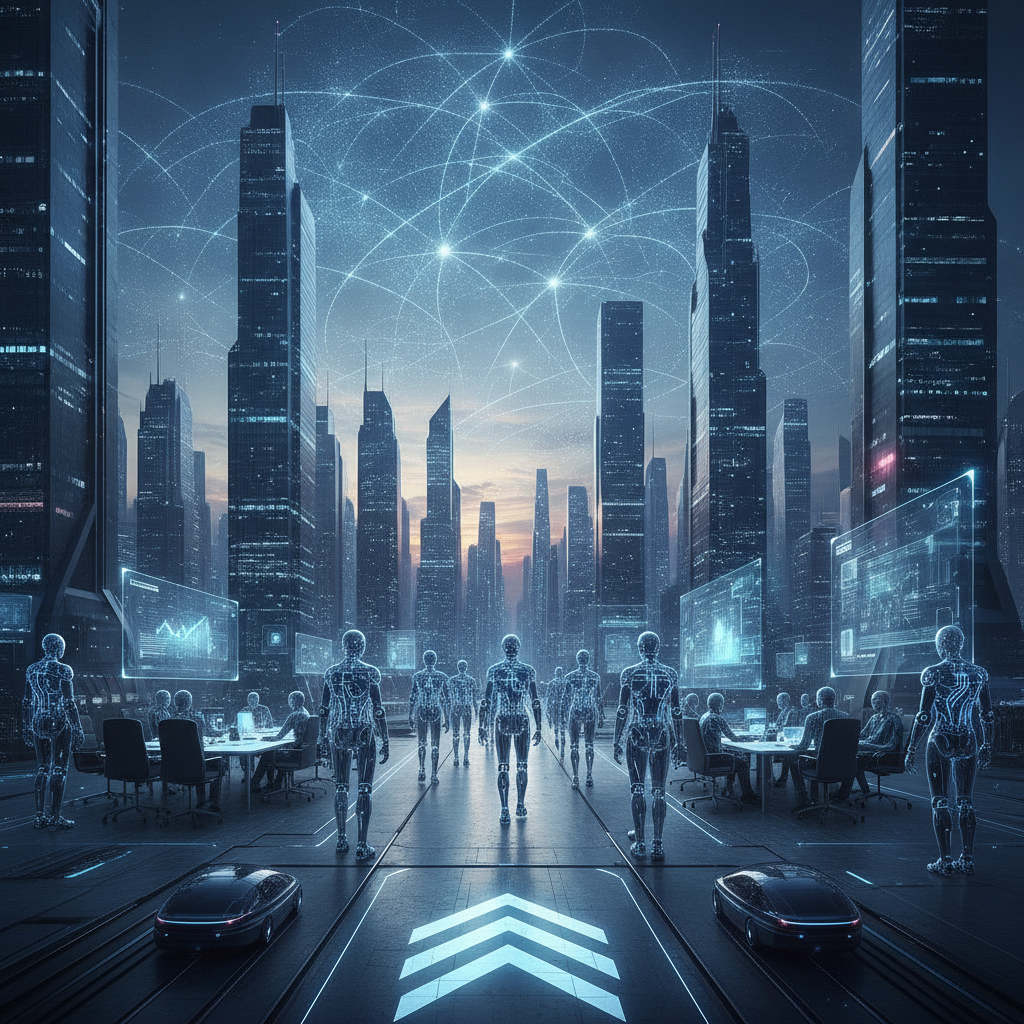
Imagine a workforce where some of your most repetitive, time-consuming tasks are handled not by humans, but by highly capable, autonomous AI entities. This isn't science fiction; it's the reality emerging with the rise of AI employees. These are advanced AI agents designed to autonomously perform complex tasks, make decisions, and interact with systems and humans, often taking on roles traditionally held by human workers within an organization.
As businesses seek new ways to enhance efficiency, scalability, and innovation, understanding and integrating AI employees will become a critical differentiator. This guide will clarify what AI employees are, how they differ from simpler AI tools, and how your organization can strategically adopt them.
Table of Contents
- What is an AI Employee?
- AI Employees vs. Traditional AI Tools and Chatbots
- Key Characteristics of an AI Employee
- Roles AI Employees Can Fulfill in Your Business
- Benefits of Integrating AI Employees
- Challenges and Considerations
- How to Implement AI Employees in Your Organization
- The Future of Work with AI Employees
- Frequently asked questions
What is an AI Employee?
An AI employee is an advanced form of AI agent that functions with a high degree of autonomy, equipped with the ability to understand complex goals, plan multi-step actions, execute tasks, and adapt its behavior based on feedback and new information. Unlike basic AI tools that perform specific, pre-programmed functions, an AI employee operates with a broader scope, mimicking aspects of human cognitive processes within a defined operational domain.
For example, instead of merely answering specific customer queries (like a chatbot), an AI employee in customer service might proactively identify at-risk customers, craft personalized retention strategies, and execute them by coordinating with various internal systems, all without direct human intervention for each step.
AI Employees vs. Traditional AI Tools and Chatbots
The core difference between AI employees and traditional AI tools or chatbots lies in their autonomy, reasoning capabilities, and ability to manage complex, multi-stage objectives. While chatbots excel at conversational interfaces and answering defined questions, AI employees possess a more sophisticated architecture that enables them to act as true agents.
Traditional AI tools, such as predictive analytics software or RPA (Robotic Process Automation) bots, automate specific, often narrow, repeatable tasks. Chatbots engage in dialogue, but typically follow predefined scripts or retrieve information based on user input. In contrast, AI employees can interpret higher-level directives, break them down into sub-tasks, prioritize, learn from outcomes, and even use various tools (like accessing databases, sending emails, or scheduling meetings) to achieve an overarching goal. This agentic nature fundamentally redefines their role from mere tools to collaborative, goal-oriented entities.
Note: Understanding the distinction between a simple chatbot and a proactive AI agent is key to grasping the power of AI employees. For a deeper dive, read our article AI Agents vs Chatbots: What’s Actually Different?
Key Characteristics of an AI Employee
- Autonomy: They can operate independently, making decisions within their defined parameters without constant human oversight.
- Goal-Oriented: Designed to achieve specific, often complex, business objectives rather than simply performing isolated tasks.
- Adaptability and Learning: Capable of adjusting strategies, learning from past interactions, and improving performance over time through continuous feedback loops.
- Reasoning and Planning: Possess the ability to break down complex problems, formulate multi-step plans, and execute them logically.
- Tool Integration: Can interface with and leverage various digital tools and systems (CRM, ERP, email, calendars, databases) to perform their functions.
- Contextual Understanding: Maintain a broader understanding of ongoing tasks and business context, enabling more relevant and effective actions.
Roles AI Employees Can Fulfill in Your Business
AI employees are poised to take on a diverse array of roles across different departments, augmenting human capabilities and filling gaps in efficiency. Their versatility allows them to handle tasks that require more than just data processing, including decision-making and interaction.
- Customer Service Agent: Beyond answering FAQs, an AI employee can manage entire customer journeys, proactively resolve issues, process returns, handle personalized recommendations, and even escalate complex cases to human agents with all relevant context. This significantly enhances the customer experience in retail and other service industries.
- Marketing Strategist & Campaign Manager: An AI employee can analyze market trends, identify target audiences, generate content ideas, optimize ad spend, launch and monitor campaigns across multiple channels, and even perform A/B testing autonomously. Learn more in A Marketer's Guide to Leveraging AI for Better Campaigns.
- Operations Coordinator: In manufacturing, an AI employee might monitor supply chains, predict equipment maintenance needs, optimize production schedules, and manage inventory levels to prevent bottlenecks. Explore this further in AI in Manufacturing: Boosting Efficiency and Innovation.
- Recruitment Assistant: From sourcing and screening candidates based on detailed job descriptions to scheduling interviews and even conducting initial assessments, an AI employee can streamline the entire talent acquisition process. See our Guide to AI in Recruitment: Enhancing Talent Acquisition.
- Data Analyst & Report Generator: They can gather data from disparate sources, identify key insights, generate comprehensive reports, and present findings in an easily digestible format for human review, dramatically reducing manual analysis time.
Benefits of Integrating AI Employees
The strategic adoption of AI employees offers several compelling advantages for businesses:
- Enhanced Efficiency and Productivity: AI employees can work 24/7 without breaks, handling vast volumes of tasks and data processing far quicker than human counterparts, leading to significant increases in operational efficiency.
- Scalability: Businesses can scale their workforce on demand, deploying more AI employees during peak periods without the overheads associated with hiring and training human staff.
- Cost Reduction: While initial investment in AI infrastructure is required, the long-term operational costs are often lower than maintaining a human workforce for equivalent tasks.
- Consistency and Accuracy: AI employees perform tasks with high consistency and precision, minimizing human error and ensuring adherence to established protocols.
- Innovation and New Capabilities: By automating routine tasks, human employees are freed up to focus on strategic thinking, creativity, and complex problem-solving, fostering a more innovative work environment.
Challenges and Considerations
While the promise of AI employees is significant, their integration comes with important challenges and ethical considerations that must be addressed:
- Ethical and Governance Issues: Questions around accountability, bias in decision-making, and the ethical implications of autonomous systems require careful consideration and robust governance frameworks.
- Job Displacement and Workforce Transformation: The rise of AI employees will inevitably reshape job roles, necessitating proactive strategies for reskilling and upskilling human workers to transition into complementary roles.
- Data Privacy and Security: AI employees often handle sensitive data, requiring stringent security measures and adherence to data protection regulations.
- Integration Complexity: Deploying AI employees requires seamless integration with existing IT infrastructure, which can be complex and require specialized expertise.
- Oversight and Monitoring: Despite their autonomy, AI employees require effective monitoring systems to ensure they are performing as intended and to intervene if issues arise.
How to Implement AI Employees in Your Organization
Successfully integrating AI employees requires a strategic, phased approach, moving beyond simple tool adoption to fundamental workforce transformation.
- Assess Needs and Identify Pilot Areas: Start by identifying repetitive, rule-based processes or areas where human error is common. Look for tasks that are clearly defined, have measurable outcomes, and can deliver quick wins. Consider areas like customer support triage, initial data processing, or lead qualification.
- Develop a Robust AI Strategy: Before deployment, establish clear goals, define success metrics, and outline the ethical guidelines for your AI employees. This includes determining what level of autonomy each AI employee will have and how human oversight will be maintained. A comprehensive AI strategy is crucial.
- Design and Train Your AI Employees: Collaborate with AI specialists to design the AI agent's architecture, including its memory, reasoning capabilities, and tool integration. Train it on relevant datasets and fine-tune its performance in a controlled environment.
- Pilot Deployment and Iteration: Deploy the AI employee in a small, controlled pilot project. Closely monitor its performance, gather feedback from human colleagues, and iterate on its design and training. Be prepared to refine its parameters and capabilities based on real-world outcomes.
- Scale and Integrate: Once the pilot is successful, gradually scale the deployment across the organization. Ensure seamless integration with existing systems and workflows, providing adequate training for human employees who will collaborate with these new AI colleagues.
- Continuous Monitoring and Governance: Establish ongoing monitoring systems to track performance, identify anomalies, and ensure compliance with ethical guidelines. Regularly review and update your AI employees as business needs evolve and AI technology advances.
The Future of Work with AI Employees
The rise of AI employees heralds a significant shift in the way organizations approach work. It’s not simply about automation, but about building a collaborative ecosystem where humans and intelligent agents work in tandem, each leveraging their unique strengths. By understanding the capabilities and implications of AI employees, businesses can position themselves at the forefront of this evolution, unlocking new levels of productivity and innovation.
Frequently asked questions
Are AI employees sentient or conscious?
No, AI employees are not sentient or conscious in any human sense. They are complex algorithms and software systems designed to simulate intelligent behavior and decision-making based on vast amounts of data and programmed logic. Their actions are purely computational, lacking subjective experience or self-awareness.
Can AI employees replace all human jobs?
It is highly unlikely that AI employees will replace all human jobs. Instead, they are expected to augment human capabilities, automate repetitive tasks, and create new roles focused on AI development, oversight, and strategic application. The workforce will transform, requiring new skills and a shift towards more creative, complex problem-solving, and interpersonal roles for humans.
How do businesses ensure ethical use of AI employees?
Ensuring ethical use requires establishing clear ethical guidelines, robust governance frameworks, and continuous monitoring. This includes addressing potential biases in AI training data, ensuring transparency in AI decision-making where appropriate, protecting data privacy, and clearly defining accountability for AI actions. Regular audits and human oversight are essential.
What is the cost of implementing AI employees?
The cost of implementing AI employees varies significantly based on complexity, scale, and specific industry needs. It includes expenses for AI platform subscriptions, development and customization, data integration, ongoing maintenance, and the training of existing staff. While initial investment can be substantial, the long-term ROI often comes from increased efficiency and reduced operational costs.
Ready to explore how AI employees can transform your operations? Continue reading the Everything Agentic blog for more insights, or get in touch with us to discuss your specific needs.