
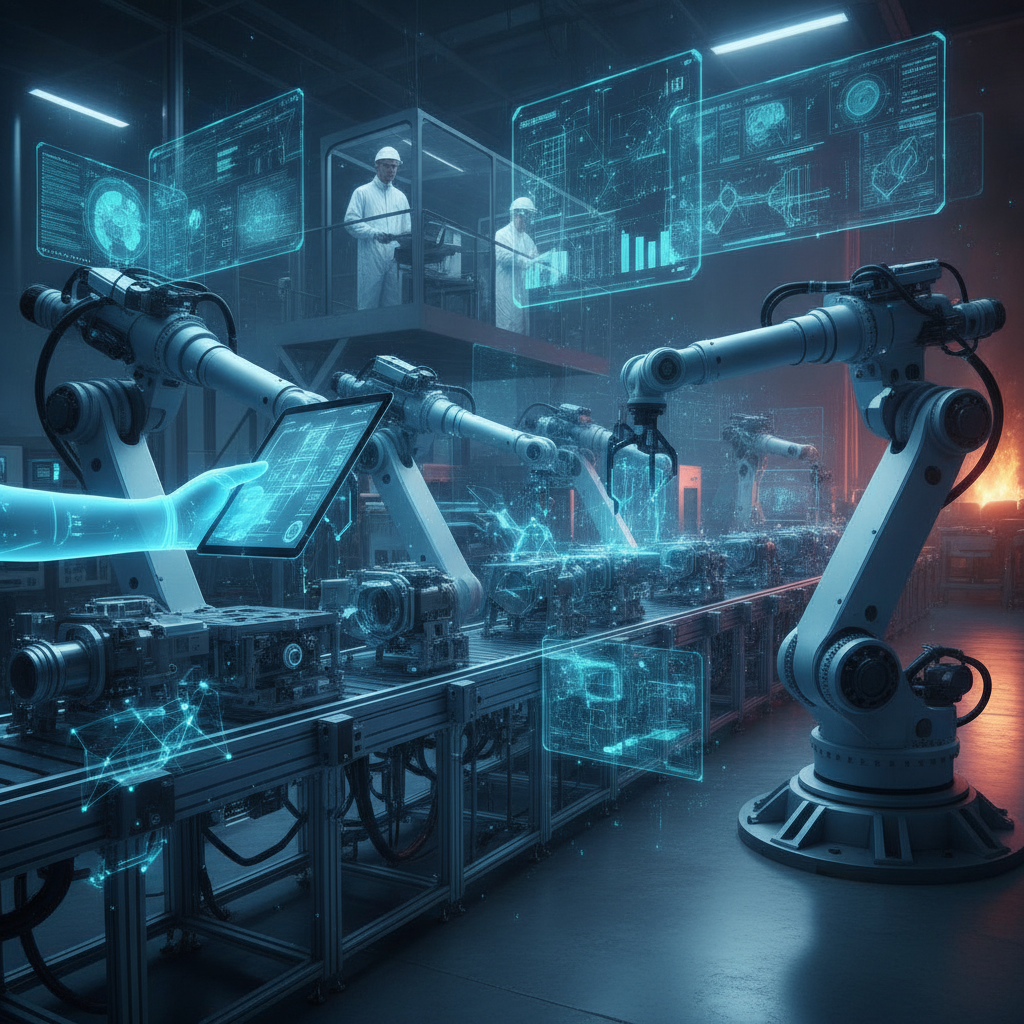
What is AI in Manufacturing?
AI in manufacturing refers to the application of artificial intelligence technologies, such as machine learning, computer vision, and natural language processing, to optimize processes, improve decision-making, and automate tasks across the entire production lifecycle. This involves everything from designing products and managing supply chains to operating machinery and ensuring quality control. Essentially, AI helps manufacturers shift from reactive to proactive, intelligent operations.
For example, instead of relying on scheduled maintenance, an AI system might analyze real-time sensor data from a machine to predict exactly when a component is likely to fail. This allows for just-in-time repairs, preventing costly downtime and extending equipment lifespan.
Why AI is Transforming Manufacturing
The integration of AI is not just an incremental improvement; it's a fundamental shift in how manufacturing operates, delivering substantial benefits that address long-standing industry challenges. Manufacturers are increasingly leveraging AI to gain competitive advantages.
Pro tip: Think of AI as your factory's new brain, capable of processing vast amounts of data to identify patterns and make decisions far faster and more accurately than human analysis alone.
Here are the key transformations AI brings:
- Enhanced Efficiency and Productivity: AI automates repetitive tasks, optimizes production schedules, and streamlines workflows, leading to faster production cycles and reduced operational costs.
- Improved Quality Control: With computer vision and machine learning, AI can detect defects with high precision, often before they become significant issues, ensuring higher product quality and reducing waste.
- Predictive Maintenance: AI algorithms analyze equipment data to forecast potential failures, enabling proactive maintenance that minimizes downtime and extends the life of valuable machinery.
- Optimized Supply Chains: AI provides better visibility into supply and demand, helping predict disruptions, optimize inventory levels, and manage logistics more effectively.
- Accelerated Innovation: AI can rapidly simulate and test new product designs, materials, and manufacturing processes, shortening development cycles and fostering quicker market introduction.
Key Applications of AI in the Factory and Beyond
AI is being deployed across numerous facets of manufacturing, from the factory floor to global supply networks. Understanding these specific applications can help identify where AI can make the most impact in your operations.
Predictive Maintenance
Predictive maintenance uses AI to analyze data from sensors, historical maintenance records, and operational parameters to foresee equipment failures before they occur. This allows maintenance teams to perform interventions precisely when needed, rather than on a fixed schedule or after a breakdown.
Example: A robotics arm on an assembly line is fitted with vibration and temperature sensors. An AI model continuously monitors this data. When it detects subtle changes indicative of bearing wear, it alerts maintenance staff to replace the bearing during a planned downtime window, preventing an unexpected failure that could halt the entire line for hours or days.
Quality Control and Defect Detection
AI-powered computer vision systems are revolutionizing quality control by inspecting products with unparalleled speed and accuracy. These systems can identify even microscopic defects that might be missed by the human eye or traditional inspection methods.
Example: In electronics manufacturing, circuit boards move down a conveyor belt. AI-driven cameras capture high-resolution images, and a deep learning model instantly compares them against perfect examples, flagging soldering errors, missing components, or misalignments in milliseconds. This ensures consistently high product quality at scale.
Supply Chain Optimization
AI algorithms can analyze vast datasets, including historical sales, market trends, weather patterns, and geopolitical events, to provide more accurate demand forecasts and optimize inventory management. This leads to reduced holding costs, fewer stockouts, and more resilient supply chains.
Example: A global automotive manufacturer uses AI to predict demand fluctuations for specific car models in different regions. This information then optimizes the ordering and logistics of thousands of components, ensuring parts arrive just-in-time at assembly plants worldwide, even amidst unforeseen disruptions.
Autonomous Robotics and Automation
While robots have long been a staple in manufacturing, AI empowers them with greater autonomy, adaptability, and learning capabilities. AI-driven robots can perform complex tasks, collaborate with human workers, and even learn from their experiences to improve performance over time.
Example: In a warehouse, autonomous mobile robots (AMRs) use AI to navigate dynamic environments, avoid obstacles, and optimize routes for picking and transporting parts to assembly stations. They can adjust their paths in real-time as human workers or other robots move through the space.
Generative Design for Product Development
Generative design leverages AI to explore thousands of design possibilities for a product or component based on specific parameters (like strength, weight, material, and manufacturing constraints). It can suggest novel designs that human engineers might not conceive, leading to lighter, stronger, and more efficient parts.
Example: An aerospace company needs to design a bracket that is as light as possible but can withstand extreme forces. An AI generative design tool, given these parameters, autonomously creates hundreds of optimized designs. Engineers can then select the best option, significantly reducing design time and material usage.
Getting Started with AI in Manufacturing: A Phased Approach
Implementing AI in manufacturing can seem daunting, but a structured, phased approach helps ensure success and maximize return on investment. Start small, learn, and scale.
- Identify Clear Pain Points: Don't implement AI for AI's sake. Pinpoint specific challenges where AI can deliver measurable value, such as reducing unplanned downtime, improving defect rates, or optimizing energy consumption.
- Assess Your Data Readiness: AI thrives on data. Evaluate your existing data infrastructure, data quality, and accessibility. You might need to invest in IoT sensors or data aggregation tools.
- Start with a Pilot Project: Choose a manageable, high-impact area for a pilot. This could be predictive maintenance on a single critical machine or AI-powered visual inspection for one product line.
- Build a Cross-Functional Team: Assemble a team with expertise in operations, IT, data science, and engineering. Collaboration is key to successful AI deployment.
- Choose the Right Technology and Partners: Select AI platforms and solutions that align with your specific needs. Consider working with technology partners who have proven experience in industrial AI.
- Monitor, Learn, and Iterate: Deploy your pilot, collect feedback, measure results, and make adjustments. AI models often need continuous training and refinement to improve performance.
- Scale Strategically: Once a pilot proves successful, identify other areas where the solution can be scaled, leveraging the lessons learned from your initial deployment.
Challenges and Considerations for AI Adoption
While the benefits of AI are significant, manufacturers must be aware of potential hurdles and plan for them accordingly.
- Data Quality and Availability: AI models are only as good as the data they are trained on. Poor quality, incomplete, or siloed data can severely hamper AI performance.
- Integration Complexity: Integrating new AI systems with existing legacy machinery and IT infrastructure can be complex and require significant investment.
- Skill Gap: A shortage of skilled AI engineers, data scientists, and operational staff capable of managing AI systems can be a major bottleneck.
- Cost of Implementation: Initial investments in hardware (sensors, powerful computing), software, and expertise can be substantial.
- Cybersecurity Risks: Connecting more devices and systems to the network increases the attack surface, making robust cybersecurity measures essential.
- Ethical and Societal Impact: Considerations around job displacement, data privacy, and algorithmic bias need to be addressed thoughtfully.
The Future of AI in Manufacturing
The journey of AI in manufacturing is only just beginning. We can expect increasingly sophisticated AI systems that offer greater autonomy, more intuitive human-AI collaboration, and hyper-personalized production capabilities. The convergence of AI with other emerging technologies like 5G, blockchain, and advanced robotics will unlock unprecedented levels of efficiency, flexibility, and innovation. Manufacturers who embrace AI today will be best positioned to thrive in the smart factories of tomorrow.
Ready to explore how AI can transform your manufacturing operations? Keep reading the Everything Agentic blog for more insights, or get in touch with us to discuss your specific needs.
Frequently asked questions
Will AI replace human workers in manufacturing?
AI is more likely to augment human workers than to completely replace them. AI excels at repetitive, data-intensive, or dangerous tasks, allowing human employees to focus on complex problem-solving, creative tasks, and strategic decision-making. It changes the nature of work, requiring new skills and fostering human-AI collaboration.
How long does it take to implement AI in a manufacturing plant?
The timeline for AI implementation varies widely depending on the complexity of the project, the readiness of the data infrastructure, and the specific application. A small pilot project for predictive maintenance might take a few months, while a full-scale integration across multiple production lines could span several years. Starting with clear, achievable goals is crucial.
What kind of data does AI in manufacturing use?
AI in manufacturing utilizes a wide range of data, including sensor data (temperature, pressure, vibration), historical maintenance logs, production output data, quality inspection results, supply chain logistics, customer demand forecasts, and even environmental conditions. The more diverse and high-quality the data, the more effective the AI models become.
Is AI only for large manufacturing companies?
While large enterprises often have greater resources for AI investments, AI solutions are increasingly becoming accessible and scalable for small and medium-sized manufacturers (SMEs). Cloud-based AI services, modular solutions, and focused pilot projects can enable SMEs to harness AI benefits without massive upfront capital. The key is to start with well-defined problems and demonstrate clear ROI.