
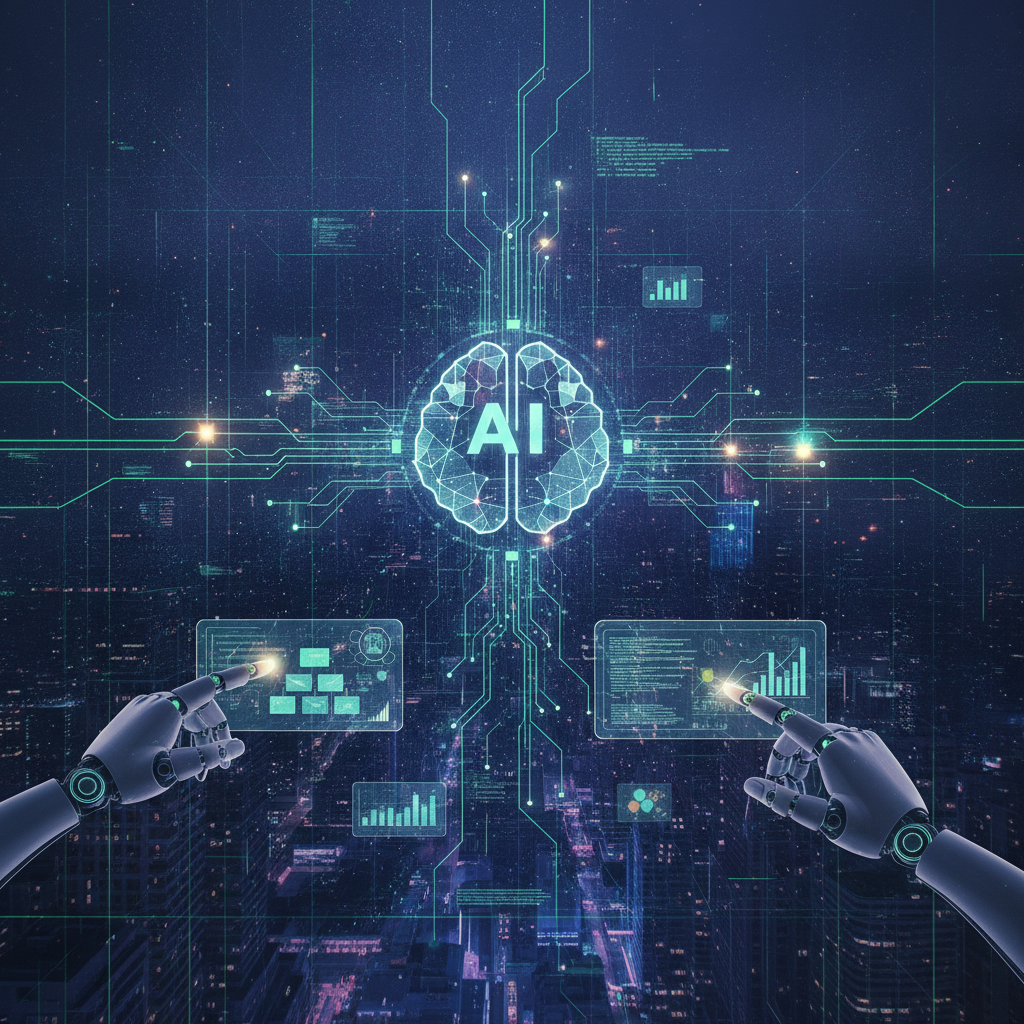
In today's rapidly evolving business landscape, the promise of artificial intelligence often feels like a distant future. Yet, the reality is that powerful AI tools are already here, ready to transform your daily operations. You don't need to wait for a distant technological breakthrough to start seeing benefits; many common business processes can be effectively automated with AI technologies available today, driving significant efficiency and strategic advantages.
This guide outlines ten practical business processes you can begin automating with AI right now, helping you enhance productivity, reduce costs, and free up your team for more strategic work.
Customer Support and Service
Automating customer support and service leverages AI to handle routine inquiries, provide instant assistance, and personalize interactions, significantly improving response times and customer satisfaction. AI-powered chatbots and virtual agents can answer frequently asked questions, guide users through troubleshooting steps, and even process simple transactions 24/7. This frees human agents to focus on complex issues that require empathy and critical thinking, leading to a more efficient and responsive support system. The differentiation between AI agents and traditional chatbots is crucial here: modern AI agents can understand context, learn from interactions, and offer more sophisticated problem-solving than their rule-based predecessors. To understand the evolution, explore AI Agents vs Chatbots: What’s Actually Different?
Content Creation and Curation
AI tools can automate various aspects of content creation and curation, from generating drafts for marketing copy and articles to summarizing long documents and suggesting relevant topics. These systems analyze vast amounts of data to produce human-like text, translate content, and even adapt tone and style to specific audiences. For example, an AI can draft product descriptions, social media posts, or internal reports in minutes, allowing human writers to refine and add a unique creative touch. This capability greatly accelerates content pipelines and ensures consistent messaging across platforms.
Data Analysis and Reporting
AI excels at processing large datasets, identifying patterns, anomalies, and insights far faster and more accurately than manual methods, making data analysis and reporting a prime candidate for automation. AI-driven analytics platforms can automatically generate comprehensive reports, predict future trends, and highlight key performance indicators (KPIs) that demand attention. This empowers businesses to make data-driven decisions swiftly, without spending countless hours manually sifting through spreadsheets. Such automation transforms raw data into actionable intelligence, providing a competitive edge.
HR and Recruitment Tasks
Automating human resources and recruitment tasks with AI streamlines tedious administrative work and enhances the candidate experience. AI can automate resume screening, identify qualified candidates based on job requirements, schedule interviews, and even answer common applicant questions. This significantly reduces the time-to-hire, minimizes unconscious bias in the initial stages, and allows HR professionals to dedicate more time to strategic workforce planning and employee development. The rise of AI employees is already reshaping the modern workforce, demonstrating AI’s expanding role in HR.
Financial Operations and Accounting
AI automation in financial operations and accounting can transform processes like invoice processing, expense reporting, fraud detection, and reconciliation. AI systems can automatically categorize transactions, flag discrepancies, and predict cash flow, reducing errors and saving significant time. For example, AI can match invoices to purchase orders and receipts, ensuring accuracy and accelerating payment cycles. This not only boosts efficiency but also enhances financial accuracy and compliance, providing clearer insights into a company's financial health.
Sales and Marketing Personalization
AI enables hyper-personalization in sales and marketing efforts by analyzing customer behavior, preferences, and engagement data to deliver tailored messages and recommendations. AI tools can automate personalized email campaigns, suggest optimal product recommendations, and even predict which leads are most likely to convert. This leads to higher conversion rates, stronger customer relationships, and more effective allocation of marketing budgets. Businesses can move beyond generic outreach to truly resonate with individual customers.
Supply Chain and Logistics Optimization
Automating supply chain and logistics processes with AI can predict demand fluctuations, optimize inventory levels, route deliveries efficiently, and identify potential disruptions before they occur. AI analyzes historical data, real-time traffic, weather conditions, and market trends to make intelligent decisions. This leads to reduced operational costs, improved delivery times, and enhanced resilience against unforeseen events. It allows businesses to maintain optimal stock, prevent stockouts, and manage complex global supply networks with greater precision.
Cybersecurity and Threat Detection
AI plays a critical role in automating cybersecurity and threat detection by continuously monitoring networks for suspicious activities, identifying potential breaches, and responding to threats in real-time. AI systems can analyze vast amounts of security data, recognize evolving attack patterns, and prioritize alerts for human analysts. This proactive approach significantly strengthens an organization's defense posture, minimizing the risk of data breaches and protecting sensitive information. As threats grow more sophisticated, AI offers an essential layer of automated protection.
IT Operations and Infrastructure Management
Automating IT operations and infrastructure management with AI helps monitor system performance, predict hardware failures, resolve common IT issues, and provision resources efficiently. AI-driven tools can identify anomalies in network traffic, automatically scale cloud resources based on demand, and even troubleshoot server problems without human intervention. This reduces downtime, optimizes resource utilization, and frees IT staff from routine maintenance tasks to focus on strategic technology initiatives. This is a clear step towards a more agentic future for IT. More insights on this can be found in Why 2026 Is the Year for Widespread Business AI Deployment.
Knowledge Management and Document Processing
AI can automate knowledge management and document processing by extracting information from unstructured text, classifying documents, and making internal knowledge bases more searchable and accessible. AI systems can rapidly scan contracts, legal documents, research papers, or customer feedback to pull out key data points, summarize content, and ensure compliance. This transforms how organizations handle vast amounts of information, making knowledge more discoverable, improving decision-making, and streamlining document-intensive workflows.
Overcoming Implementation Challenges
While the potential for AI automation is immense, successful implementation requires careful planning. Start by identifying processes that are repetitive, rule-based, and involve large volumes of data. Ensure you have clean, reliable data, as AI models are only as good as the data they are trained on. Integration with existing systems, data privacy, and ethical considerations are also crucial. Building an AI strategy is a key first step, and guidance can be found in Should Your Business Build an AI Strategy Yet? A Practical Guide.
Pro tip: Begin with a pilot project for a single, well-defined process to demonstrate AI's value and gain internal buy-in before scaling across your organization.
Measuring Success: How to Know It's Working
To confirm your AI automation efforts are yielding results, focus on measurable key performance indicators (KPIs). Track improvements in efficiency (e.g., reduced processing time, faster response rates), cost savings (e.g., lower labor costs for automated tasks), accuracy rates (e.g., fewer errors in data entry or financial reconciliation), and employee satisfaction (e.g., freeing staff from mundane tasks). Qualitative feedback from customers and employees also provides valuable insights into the tangible benefits and areas for further optimization.
Frequently asked questions
Is AI automation suitable for small businesses?
Yes, AI automation is highly suitable for small businesses. Many AI tools are now accessible, affordable, and cloud-based, allowing small businesses to automate key processes like customer support, social media management, and data analysis without significant upfront investment. It can help level the playing field by enabling small teams to operate with the efficiency of larger organizations.
What's the difference between AI automation and traditional automation?
Traditional automation, often rule-based, follows predefined scripts and workflows for repetitive tasks. AI automation, however, uses machine learning and artificial intelligence to understand, adapt, and make decisions in more complex, dynamic situations, often learning from new data without explicit programming. This allows AI to handle non-routine tasks, personalize interactions, and extract insights that traditional automation cannot.
How long does it take to implement AI automation?
The implementation timeline for AI automation varies significantly based on the complexity of the process and the tools used. Simple integrations, like a chatbot for FAQs, might take weeks. More complex projects, such as integrating AI into an entire supply chain, could take several months to a year. Starting with well-defined pilot projects can yield quick wins and build momentum for larger initiatives.
What are the first steps to identifying processes for AI automation?
Begin by auditing your current business processes to identify those that are highly repetitive, time-consuming, prone to human error, or involve large volumes of data. Look for tasks that don't require human empathy, creativity, or complex judgment. Prioritize processes where automation can deliver clear, measurable benefits, such as cost reduction or improved customer experience.
Embrace AI Automation for a Smarter Future
The ability to automate business processes with AI is no longer a future aspiration; it's a current reality offering tangible benefits today. By strategically implementing AI, you can unlock new levels of efficiency, innovation, and competitive advantage. The journey to a more agentic business begins with identifying these opportunities and taking the first step.
Ready to explore how AI can transform your operations? Continue reading the Everything Agentic blog for more insights, or get in touch with our team to discuss your specific needs.