
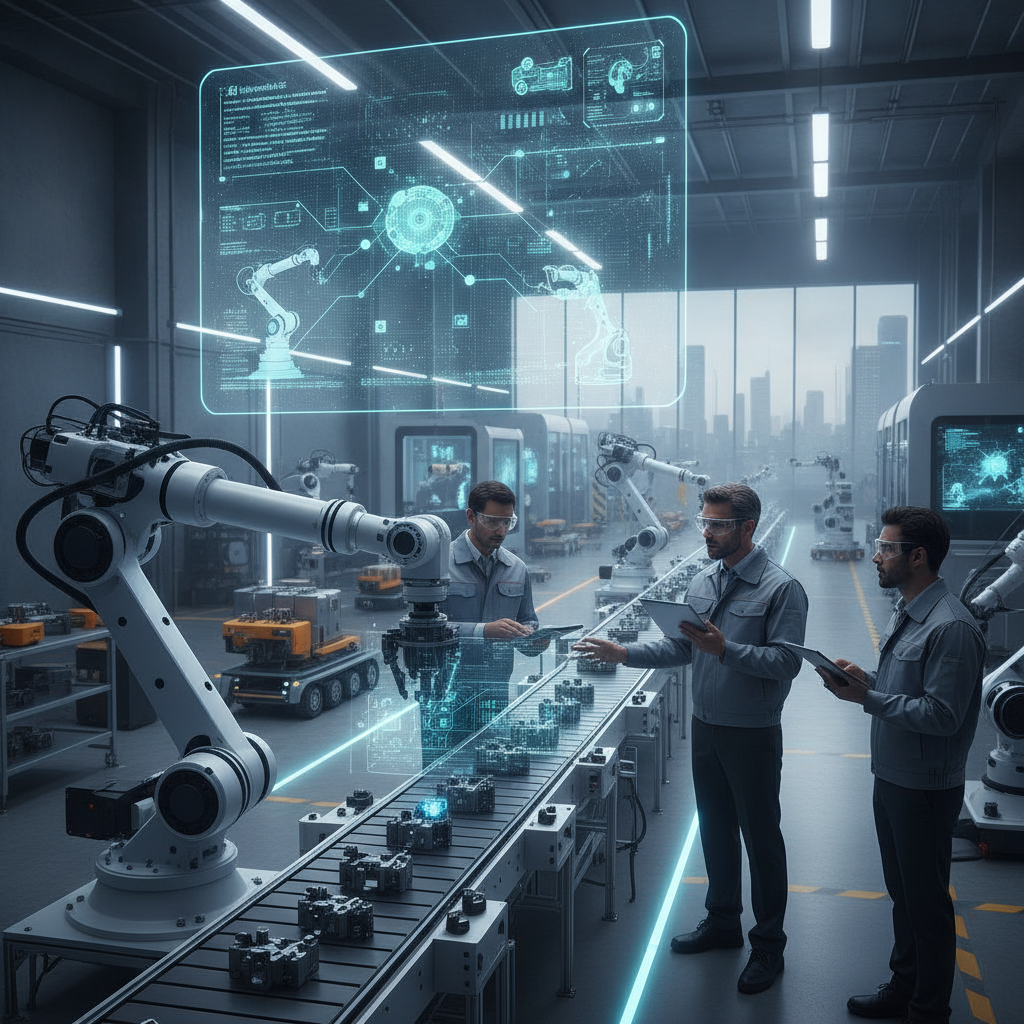
Manufacturing operations today are more complex than ever, facing pressures from global supply chains, increasing customer demands, and the constant need for efficiency. Traditional methods often struggle to keep pace with these dynamics, leading many industry leaders to seek advanced solutions. This is where artificial intelligence (AI) in manufacturing steps in, leveraging advanced algorithms and data analytics to optimize production processes, predict maintenance needs, enhance quality control, and improve supply chain efficiency, ultimately driving significant operational improvements and innovation.
This guide will illuminate the practical applications of AI in manufacturing, detailing how it solves real-world problems and what benefits you can expect. We will explore key areas where AI is making a tangible difference, from the factory floor to the logistics network, providing you with a clear roadmap for understanding and exploring AI adoption in your own operations.
Table of Contents
- Optimizing Production Processes with AI
- Enhancing Predictive Maintenance
- Revolutionizing Quality Control
- Streamlining Supply Chain and Logistics
- Boosting Product Design and Development
- Challenges and Considerations for AI Implementation
- Measuring the Impact of AI in Manufacturing
- Frequently asked questions
Optimizing Production Processes with AI
AI optimizes manufacturing production processes by analyzing vast datasets from sensors, machines, and historical records to identify inefficiencies, predict bottlenecks, and recommend adjustments in real time. This leads to more agile and responsive production lines.
For instance, AI algorithms can dynamically adjust machine settings, such as temperature, pressure, or speed, to maintain optimal output and energy consumption based on current conditions and material properties. This reduces waste, improves yield, and accelerates production cycles. Consider a scenario where a production line manufactures various products on the same equipment. AI can learn the optimal changeover sequences and machine configurations for each product, minimizing downtime and maximizing throughput.
Enhancing Predictive Maintenance
Predictive maintenance uses AI to analyze data from industrial sensors (vibration, temperature, acoustics) to forecast equipment failures before they occur. This shifts maintenance from reactive or time-based schedules to an as-needed basis, significantly reducing unplanned downtime and maintenance costs.
Instead of relying on fixed maintenance schedules or waiting for a breakdown, AI models can detect subtle anomalies in equipment performance that indicate impending failure. For example, a slight increase in a motor's operating temperature or a change in vibration patterns, imperceptible to human operators, can trigger an AI alert. This allows maintenance teams to perform targeted repairs during planned downtime, extending equipment lifespan and ensuring continuous operation. This contrasts sharply with traditional preventative maintenance, which often involves unnecessary servicing of healthy components.
Revolutionizing Quality Control
AI revolutionizes quality control by enabling automated, high-speed inspection systems that can identify defects with greater accuracy and consistency than human inspectors. This reduces scrap rates, improves product reliability, and ensures compliance with stringent quality standards.
Using computer vision, AI-powered cameras can inspect products for surface flaws, misalignments, or missing components at various stages of production. These systems can learn from vast numbers of images of both perfect and defective products, classifying anomalies in real time. For example, in electronics manufacturing, AI can quickly detect microscopic solder joint defects that might be missed by the human eye or traditional automated optical inspection (AOI) systems. This proactive defect detection means problems are caught earlier, preventing faulty products from moving further down the line or reaching customers.
Streamlining Supply Chain and Logistics
AI streamlines supply chain and logistics operations by improving demand forecasting, optimizing inventory management, and enhancing route planning. This leads to reduced lead times, lower operational costs, and greater resilience against disruptions.
By analyzing historical sales data, market trends, weather patterns, and even social media sentiment, AI can create more accurate demand forecasts than traditional statistical methods. This allows manufacturers to optimize inventory levels, reducing carrying costs and minimizing stockouts. Furthermore, AI algorithms can dynamically optimize delivery routes, considering real-time traffic, vehicle capacity, and delivery windows, ensuring timely and cost-effective product distribution. In times of disruption, AI can quickly identify alternative suppliers or routes, helping to maintain operational continuity.
Boosting Product Design and Development
AI accelerates product design and development by enabling generative design, simulating performance, and analyzing market feedback. This allows manufacturers to create innovative products faster and more efficiently, tailored to market needs.
Generative design tools, powered by AI, can explore thousands of design iterations based on specific parameters like material properties, strength requirements, and manufacturing constraints. This can lead to highly optimized and novel designs that human designers might not conceive. AI can also simulate how a product will perform under various conditions, reducing the need for expensive physical prototypes and accelerating testing cycles. By analyzing customer reviews and usage data, AI can also provide insights into desired product features and areas for improvement, guiding future development.
Pro tip: When implementing AI in product design, focus on defining clear objectives and constraints. AI performs best when it has well-defined boundaries to explore design solutions within.
Challenges and Considerations for AI Implementation
While the benefits of AI in manufacturing are clear, successful implementation requires addressing several key challenges, including data quality, integration complexity, and the need for new skill sets.
- Data Quality and Availability: AI models are only as good as the data they are trained on. Manufacturers often face challenges with fragmented data sources, inconsistent formats, and incomplete historical records. Ensuring clean, relevant, and sufficient data is a foundational step.
- Integration with Existing Systems: Manufacturing environments often rely on legacy systems. Integrating new AI solutions with existing Enterprise Resource Planning (ERP), Manufacturing Execution Systems (MES), and Industrial Control Systems (ICS) can be complex and require careful planning.
- Skill Gap: Implementing and maintaining AI solutions requires specialized skills in data science, machine learning engineering, and AI ethics. Organizations may need to invest in training existing staff or hiring new talent to bridge this gap.
- Cost and ROI: Initial investment in AI hardware, software, and expertise can be substantial. Clearly defining the expected return on investment (ROI) and starting with pilot projects can help manage costs and demonstrate value incrementally.
- Cybersecurity Risks: Connecting more systems and gathering more data also expands the attack surface. Robust cybersecurity measures are essential to protect sensitive operational data and prevent malicious interference with AI-driven processes.
Measuring the Impact of AI in Manufacturing
To ensure AI initiatives deliver tangible value, it is crucial to establish clear metrics and continuously monitor their performance. Measuring the impact of AI in manufacturing involves tracking both direct operational improvements and broader business outcomes.
- Operational Efficiency: Key performance indicators (KPIs) include reduction in machine downtime, increase in production throughput, decrease in scrap rates, and optimization of energy consumption.
- Cost Savings: Track reductions in maintenance costs (due to predictive maintenance), inventory holding costs (due to optimized inventory), and labor costs (from automation of repetitive tasks).
- Quality Improvement: Monitor defect rates, customer return rates, and compliance with quality standards. AI's ability to identify minute flaws can significantly improve these metrics.
- Supply Chain Resilience: Evaluate improvements in on-time delivery rates, reduction in lead times, and the ability to mitigate supply chain disruptions.
- Innovation and Time-to-Market: Quantify the speed of new product development cycles and the number of innovative designs generated through AI-assisted tools.
By regularly reviewing these metrics, manufacturers can refine their AI strategies, scale successful initiatives, and demonstrate clear value to stakeholders.
Frequently asked questions
What types of AI are most commonly used in manufacturing?
The most commonly used types of AI in manufacturing include machine learning for predictive analytics and process optimization, computer vision for quality control and robotic guidance, and natural language processing for human-machine interaction and data analysis.
Is AI suitable for small and medium-sized manufacturers (SMEs)?
Yes, AI is increasingly accessible to SMEs. While large enterprises might implement complex, facility-wide systems, SMEs can start with targeted AI solutions for specific problems, such as predictive maintenance on a critical machine or AI-powered visual inspection for a key product line. Cloud-based AI services also lower the entry barrier.
How long does it take to implement AI in a manufacturing plant?
The implementation timeline for AI in a manufacturing plant varies significantly based on scope. Pilot projects targeting specific use cases might take 3-6 months, while broader, more integrated deployments across multiple processes could extend from 1-3 years. Factors like data readiness, system integration complexity, and internal expertise play a crucial role.
Will AI replace human jobs in manufacturing?
AI is more likely to augment human capabilities and reshape job roles rather than eliminate them entirely. While AI can automate repetitive or hazardous tasks, it creates new demands for roles in AI system management, data analysis, maintenance of AI-powered machinery, and strategic decision-making. The focus shifts towards human-AI collaboration.
As AI continues to evolve, its role in manufacturing will only expand, driving smarter factories, more efficient processes, and innovative product lines. Embracing these technologies isn't just about keeping pace; it's about leading the way in a competitive global landscape.
Want to learn more about how AI is transforming various industries? Explore our other guides on the Everything Agentic blog, such as A Practical Guide to AI in Marketing or AI in Healthcare: A Practical Guide. For personalized advice, feel free to get in touch with Everything Agentic to discuss your specific needs.