
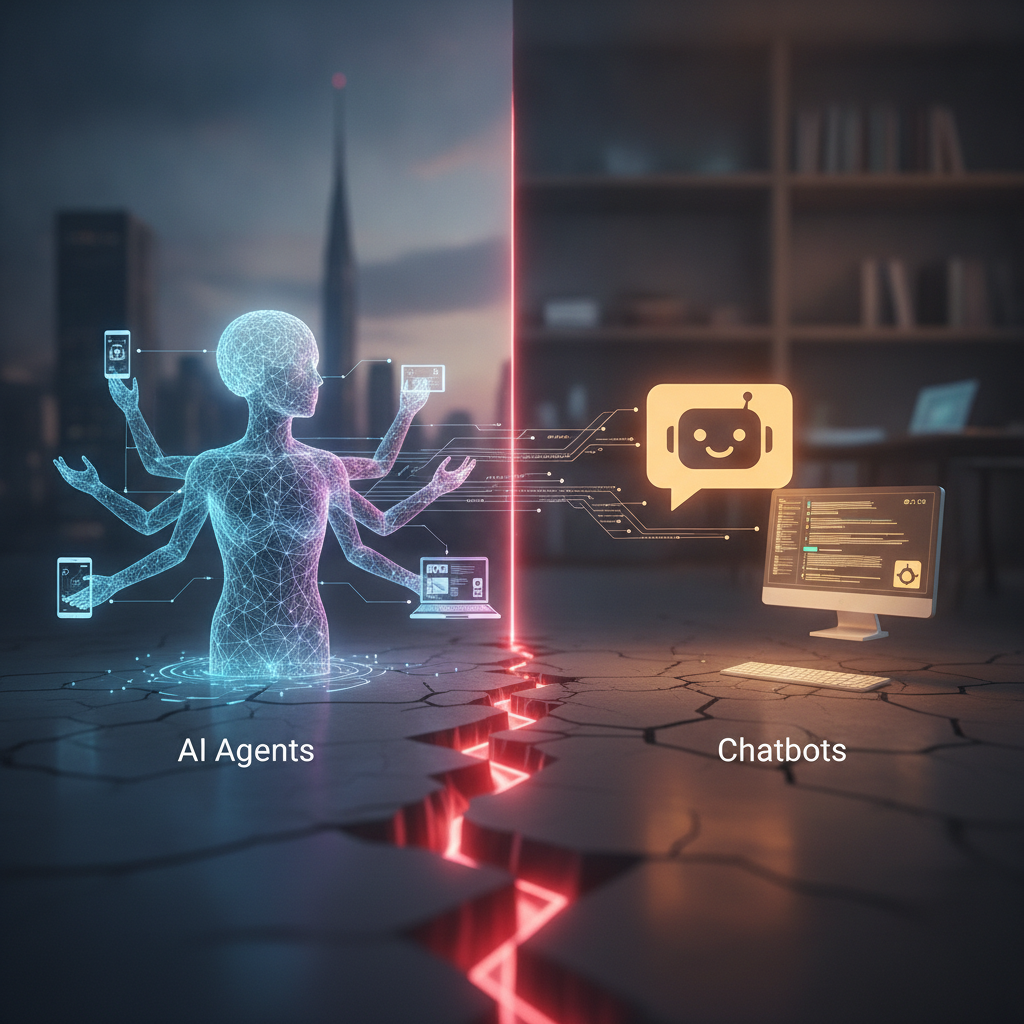
In the evolving landscape of artificial intelligence, terms like 'AI agent' and 'chatbot' are often used interchangeably, leading to confusion. However, despite their shared reliance on Large Language Models (LLMs) and natural language understanding, these two technologies serve distinct purposes and possess fundamentally different capabilities. Understanding these differences is crucial for any business looking to implement AI effectively.
The primary distinction lies in their operational paradigm: chatbots are reactive conversational interfaces, designed to respond to user queries within predefined boundaries, while AI agents are autonomous, goal-oriented systems capable of planning, executing multi-step tasks, and adapting to dynamic environments. Deciding between an AI agent and a chatbot hinges on the complexity and autonomy required by your specific use case.
AI Agents vs. Chatbots: A Quick Comparison
| Feature | AI Agents | Chatbots |
|---|---|---|
| Purpose | Autonomous task execution, goal achievement | Conversational interaction, information retrieval |
| Autonomy | High: Plans, executes, and adapts independently | Low: Reacts to user input within defined scope |
| Memory | Long-term, contextual understanding, self-reflection | Short-term (current conversation), limited persistence |
| Tool Use | Extensive: Integrates and uses external tools (APIs, web) | Limited: Primarily text-based responses or simple internal functions |
| Proactivity | Proactive: Initiates actions to achieve goals | Reactive: Responds only when prompted |
| Complexity | High: Involves planning, reasoning, continuous learning | Moderate: Relies on scripts, knowledge bases, or simple LLM prompts |
| Adaptability | High: Learns and adjusts strategies during execution | Low: Follows pre-programmed paths or fixed LLM instructions |
| Typical Use Cases | Automated research, complex workflow automation, personalized assistants | Customer service FAQs, lead qualification, simple booking |
What is a Chatbot?
A chatbot is a computer program designed to simulate human conversation through text or voice. Its primary function is to engage users in dialogue, answer questions, and perform simple tasks based on predefined rules or a trained dataset. Chatbots excel at managing structured conversations and providing immediate responses to common queries.
How Chatbots Work
Traditional chatbots operate on rule-based systems, decision trees, or keyword recognition. More advanced chatbots, often powered by Large Language Models (LLMs), can understand natural language more flexibly, generating more human-like responses. However, even LLM-powered chatbots typically remain reactive; they wait for a user's input and then generate a response based on their training data and current conversational context.
Strengths of Chatbots
- Instant Responses: Quickly address common customer inquiries.
- Scalability: Handle a large volume of simultaneous conversations.
- Cost-Effective: Reduce the need for human agents for routine tasks.
- User-Friendly: Provide a familiar conversational interface for information access.
Limitations of Chatbots
- Limited Scope: Struggle with questions outside their programmed domain or knowledge base.
- Lack of Initiative: Cannot initiate actions or plan multi-step solutions independently.
- Context Drift: May lose context in long or complex conversations.
- Repetitive: Can feel frustrating when unable to solve novel problems.
Best Fit for Chatbots
Chatbots are ideal for applications where the interactions are relatively predictable and involve answering questions, providing information, or guiding users through simple processes. Think customer service, FAQs, basic technical support, or lead qualification.
For example, a chatbot on an e-commerce site can help customers track an order, answer questions about shipping policies, or suggest products based on simple preferences. These tasks are self-contained and don't require external tool use or complex decision-making.
What is an AI Agent?
An AI agent is a more sophisticated system designed to autonomously achieve specific goals in complex, dynamic environments. Unlike chatbots, agents possess a broader understanding of their objective, can break down complex tasks into sub-tasks, plan sequences of actions, use external tools, learn from their experiences, and adapt their strategies to achieve their desired outcome.
How AI Agents Work (The Agentic Loop)
The core of an AI agent's functionality lies in its agentic loop, which typically involves these stages:
- Perception: The agent observes its environment and gathers information relevant to its goal.
- Reasoning/Planning: It processes the information, updates its internal state, and plans the next steps towards its goal. This often involves using an LLM for complex reasoning.
- Action: The agent executes the planned actions, which might involve using external tools, interacting with systems, or generating responses.
- Reflection/Learning: It evaluates the outcome of its actions, learns from successes and failures, and updates its strategy or understanding for future tasks. This continuous feedback loop allows for greater autonomy and adaptability.
Strengths of AI Agents
- Autonomous Goal Achievement: Can handle complex, multi-step tasks without constant human oversight.
- Adaptability: Learns and adjusts strategies in real-time.
- Tool Integration: Seamlessly interacts with various external systems (APIs, databases, web browsers) to perform actions.
- Proactive Problem Solving: Identifies problems or opportunities and initiates actions to address them.
Limitations of AI Agents
- Complexity: More challenging to design, develop, and deploy than chatbots.
- Cost: Often requires more computational resources and advanced engineering.
- Error Propagation: An error in one step of a multi-step plan can lead to incorrect outcomes.
- Ethical Concerns: Higher autonomy raises new ethical considerations regarding control and accountability.
Best Fit for AI Agents
AI agents are suited for scenarios demanding higher autonomy, complex decision-making, and the ability to perform actions across multiple systems. They excel in dynamic environments where objectives might evolve, and new information needs to be incorporated into planning.
For instance, an AI agent could automate the entire process of researching a market, drafting an initial report, and even scheduling follow-up meetings by interacting with web search tools, document creation software, and calendar applications. Another example could be an agent that manages social media campaigns, analyzing trends, generating content, scheduling posts, and adjusting strategies based on engagement metrics.
Key Differences Explained
Let's dive deeper into the core distinctions that set AI agents apart from chatbots.
Autonomy and Initiative
The most significant difference is autonomy. Chatbots are inherently reactive; they wait for a user's prompt and then respond. They don't initiate actions or pursue goals independently. AI agents, conversely, are proactive. Once given a goal, they autonomously plan and execute a sequence of actions, even modifying their approach if initial attempts fail, without requiring constant human intervention.
Memory and Context Management
Chatbots typically maintain short-term memory, primarily within the current conversational turn. While some can recall limited past interactions, their ability to store and leverage long-term, self-reflective memory is minimal. AI agents, however, often incorporate sophisticated memory systems that allow them to recall past experiences, internalize lessons learned, and use this knowledge to inform future decisions. They can self-reflect on their actions and update their understanding of the world, much like a human learning from experience.
Tool Use and Action Capabilities
Chatbots usually perform actions limited to generating text responses or triggering simple, predefined internal functions. They aren't typically designed to interact broadly with external software or APIs. AI agents, on the other hand, are built with extensive tool-use capabilities. They can integrate with and operate a wide array of external applications, databases, and web services, allowing them to perform real-world actions like sending emails, updating CRM records, analyzing data, or browsing the internet.
Planning and Reasoning
A chatbot's