
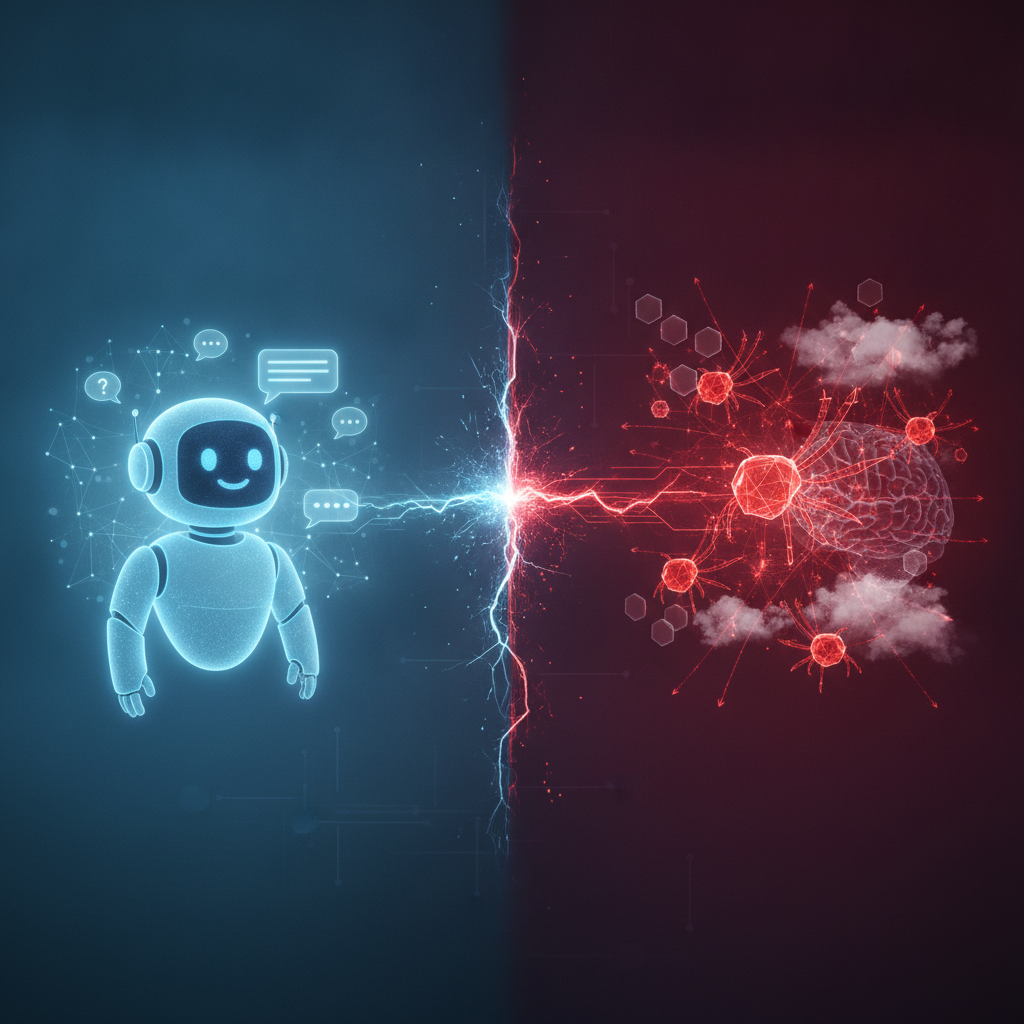
The world of artificial intelligence is evolving at lightning speed, and with it, the terminology can sometimes get a little fuzzy. Two terms often used interchangeably, yet fundamentally distinct, are "AI Agents" and "Chatbots." You've likely interacted with chatbots on customer service websites or through virtual assistants on your phone. But what exactly is an AI Agent, and how does it differ from a chatbot? Is it just a fancier name for the same thing?
At Everything Agentic, we believe understanding these distinctions is crucial to appreciating the true potential of AI. While both can leverage large language models (LLMs) and seem conversational, their core architecture, capabilities, and underlying purpose are profoundly different. Let's peel back the layers and uncover what truly separates an AI Agent from a chatbot.
Think of a chatbot as a conversational interface designed primarily for interaction. Its main goal is to respond to user prompts, provide information, or automate simple, predefined tasks within a limited scope. Chatbots excel at answering frequently asked questions, guiding users through basic processes like resetting a password, or taking simple orders.
Most chatbots operate on a reactive basis. They wait for a user's input, process it against their training data or a set of predefined rules, and then generate a response. They typically have a short memory, often limited to the current conversation turn or a very small context window, making them largely "stateless" beyond that immediate interaction. If you restart the chat, it often forgets everything that came before. They might use a large language model (LLM) to make their responses sound natural and to understand a wider range of phrasing, but their actions are usually confined to generating text, retrieving information from a database, or triggering a simple API call (like booking an appointment if the system is designed for it). They don't typically initiate actions or proactively pursue complex goals. They're excellent at "what you ask for, I will respond to," but less so at "what you need, I will figure out and do."
Now, let's turn our attention to AI Agents. An AI Agent is a more sophisticated construct, designed not just to converse, but to autonomously achieve a specific, often complex, goal. Imagine an assistant that doesn't just answer your questions but takes initiative, plans, acts, and even course-corrects to get a job done. That's an AI Agent.
The defining characteristics of an AI Agent are:
1. Goal-Oriented: Unlike a chatbot that responds to a prompt, an agent has a clear objective, such as "research the best marketing strategies for a new SaaS product" or "develop a basic Python script to scrape data from X website." 2. Autonomy: Agents can operate independently. Once given a goal, they can make decisions, select tools, and execute steps without constant human intervention. 3. Perception: They can "perceive" their environment, taking in information from various sources like web pages, documents, databases, or user input. 4. Reasoning and Planning: This is a crucial differentiator. Agents can break down a complex goal into smaller, manageable sub-tasks. They can strategize, anticipate potential issues, and formulate a plan of action. 5. Action: Agents are not limited to just generating text. They can interact with the world by calling APIs, running code, using web browsers, sending emails, or manipulating data. They have "effectors" – ways to act. 6. Memory and Learning: Beyond short-term context, agents often possess persistent memory. They can store past experiences, learn from successes and failures, and adapt their strategies over time to improve performance on similar tasks. 7. Iteration and Self-Correction: Agents can monitor their progress. If a step fails or the outcome isn't as expected, they can reflect on the failure, diagnose the problem, replan, and try a different approach until the goal is achieved or they determine it's impossible. This reflective capability is key to their robustness.
To make the distinction even clearer, let's look at a direct comparison:
Purpose: A chatbot's primary purpose is interaction and information exchange. An AI Agent's primary purpose is goal achievement and problem-solving through a series of autonomous actions.
Autonomy Level: Chatbots are largely reactive; they wait for your input. AI Agents are proactive and self-directed; they initiate actions to fulfill their objective.
Memory and State: Most chatbots are largely stateless, with a limited conversational memory. AI Agents maintain persistent memory, learn from past interactions, and build an internal model of their progress towards a goal.
Actions and Tools: Chatbots typically generate text or trigger simple, predefined actions. AI Agents can utilize a wide array of external tools (APIs, web browsers, code interpreters, databases) to perform complex, multi-step operations.
Reasoning Capability: Chatbots primarily rely on pattern matching, keyword recognition, and often direct information retrieval. AI Agents engage in complex reasoning, task decomposition, strategic planning, and iterative refinement.
Complexity of Tasks: Chatbots handle straightforward, often single-turn or limited multi-turn interactions. AI Agents are designed for complex, multi-stage, and even multi-day projects that require sustained effort and adaptation.
Error Handling: If a chatbot encounters an unexpected input or a task it can't handle, it often gets stuck or escalates to a human. AI Agents are built with reflection and self-correction mechanisms to diagnose issues and attempt alternative solutions.
Consider the different types of problems they solve:
Chatbot Use Cases: * Customer support FAQs: "What are your business hours?" * Basic lead generation: "Are you interested in a demo?" * Appointment scheduling: "Book me for a haircut next Tuesday." * Simple information retrieval: "What's the weather like in Paris?" * Virtual assistants for basic commands: "Set a timer for 10 minutes."
AI Agent Use Cases: * Automated market research: An agent browses competitor websites, analyzes product reviews, and compiles a summary report of market gaps and opportunities. * Personalized learning systems: An agent assesses a student's progress, identifies weak areas, then generates custom exercises and finds relevant educational resources, adapting its approach based on performance. * Code generation and debugging: An agent takes a high-level description of a desired software feature, writes the code, tests it, identifies bugs, and iteratively refines the code until it meets specifications. * Supply chain optimization: An agent monitors inventory levels, analyzes demand forecasts, negotiates with suppliers through API calls, and automatically places orders to minimize costs and prevent stockouts. * Data analysis and reporting: An agent retrieves data from multiple databases, cleans it, performs complex statistical analysis, generates visualizations, and writes a comprehensive report, all with minimal human oversight.
The shift from chatbots to AI Agents represents a profound evolution in how we interact with and leverage artificial intelligence. It moves AI beyond being merely a conversational interface to becoming an active, intelligent partner capable of taking initiative and executing tasks in the real world. This "agentic" paradigm is about empowering AI systems to not just understand our requests, but to actively work towards our goals, making them incredibly powerful tools for productivity, innovation, and problem-solving across virtually every industry. It means moving from asking AI "what is X?" to telling AI "make X happen."
In essence, while chatbots are excellent conversationalists and helpful for specific, predefined interactions, AI Agents are the true doers. They are the proactive problem-solvers, capable of navigating complexity, making decisions, and autonomously taking steps to achieve significant objectives. Understanding this core difference is key to harnessing the next wave of AI innovation. As we continue to build more sophisticated systems, the line between intelligent interaction and autonomous action will become even more critical to distinguish, paving the way for truly transformative applications.